

DATA DROP - NEW CONDO TAXES
Last updated: November 3, 2026
This post is part of the Decode Data Drop, my weekly series where I pull the real numbers behind New York real estate and share what they actually mean for buyers. Receipts, not vibes. A new drop goes up every Thursday on Instagram, so follow along at @katiekeatejohnson to catch the next one.
Every new condo listing shows a monthly tax number. Buyers budget around it, lenders qualify you on it, and almost nobody checks it against the bill the city actually sends once the building is finished.
So I did. I took 30 new condo buildings, 10 each in Brooklyn, Manhattan and Queens, and compared the tax on the first sponsor listing for 345 units with the actual 2026-27 Department of Finance tax bill for the same units. Here is how far apart they landed.
Quick Overview
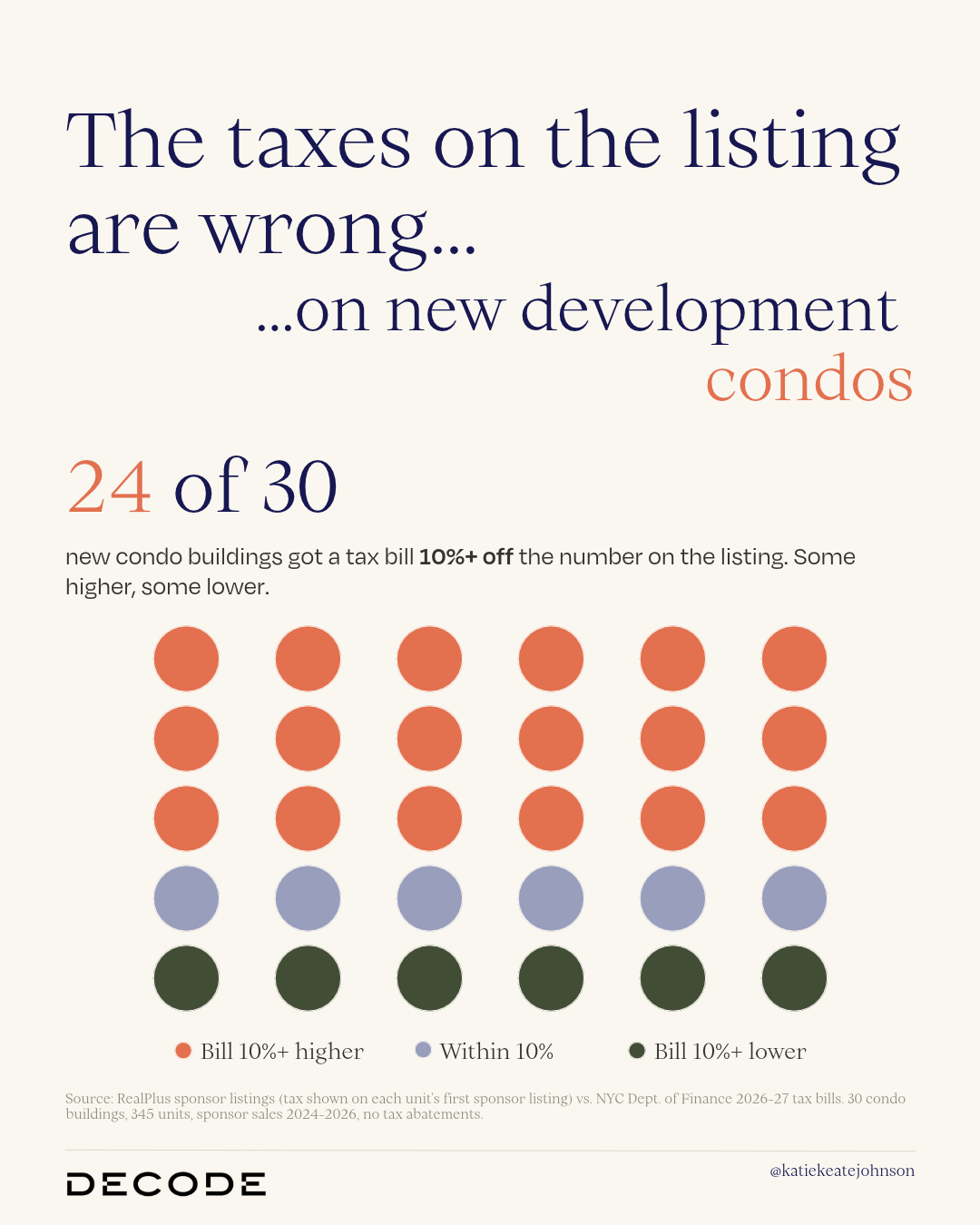
24 of 30 buildings missed their advertised taxes by 10% or more, in one direction or the other.
+15% is how much more the median unit is actually billed than its listing advertised, across all 345 units.
+27% in Brooklyn, the widest gap of the three boroughs, versus +19% in Queens and +5% in Manhattan.
The Numbers
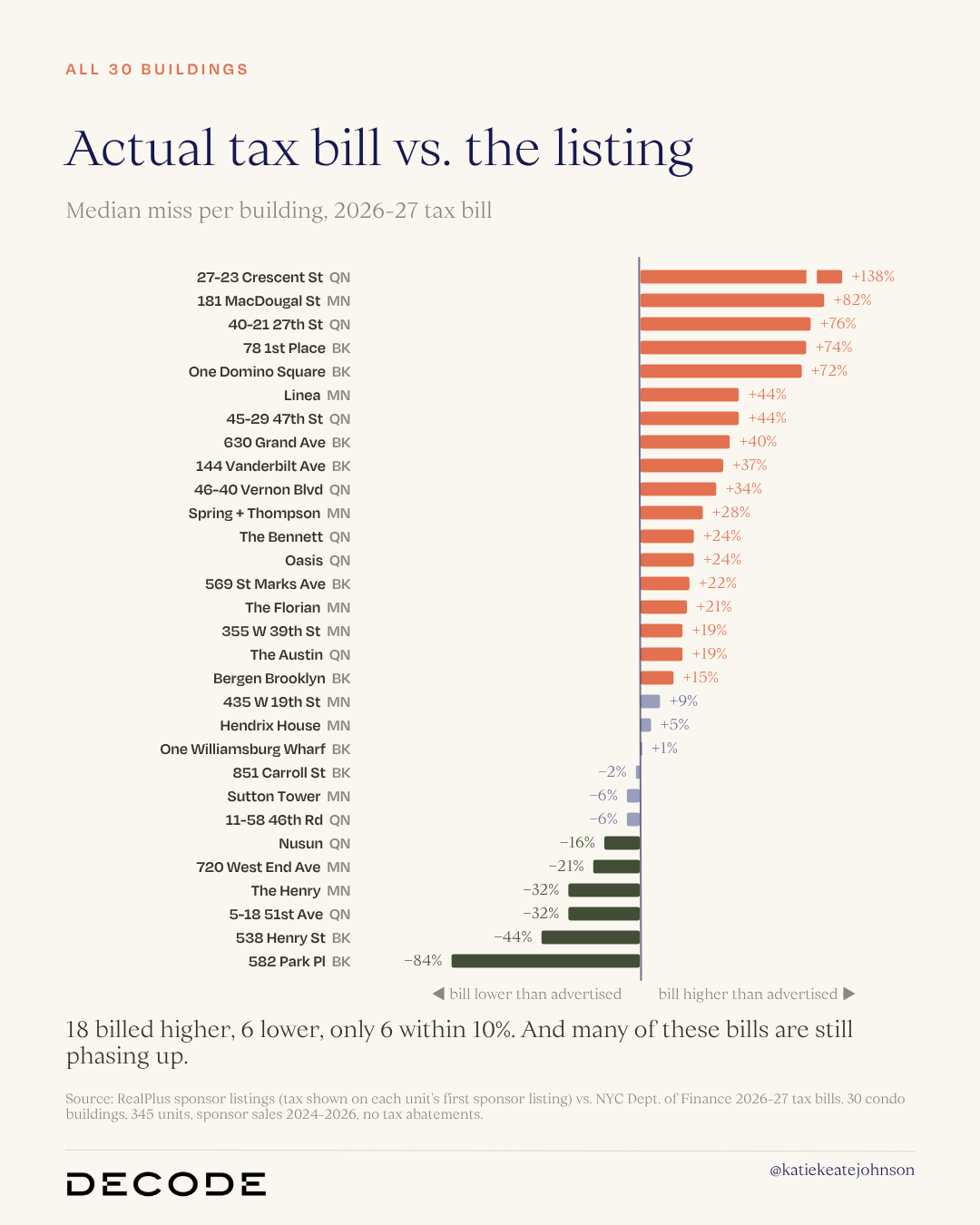
1. Actual tax bill vs. listing, all 30 buildings
NYC · 30 new condo buildings, 345 units · actual tax bill vs. advertised
18 buildings are billed more than 10% above what their listings advertised, 6 landed within 10%, and 6 came in more than 10% lower. Across all 345 units, the median unit pays 15% more than its listing said.
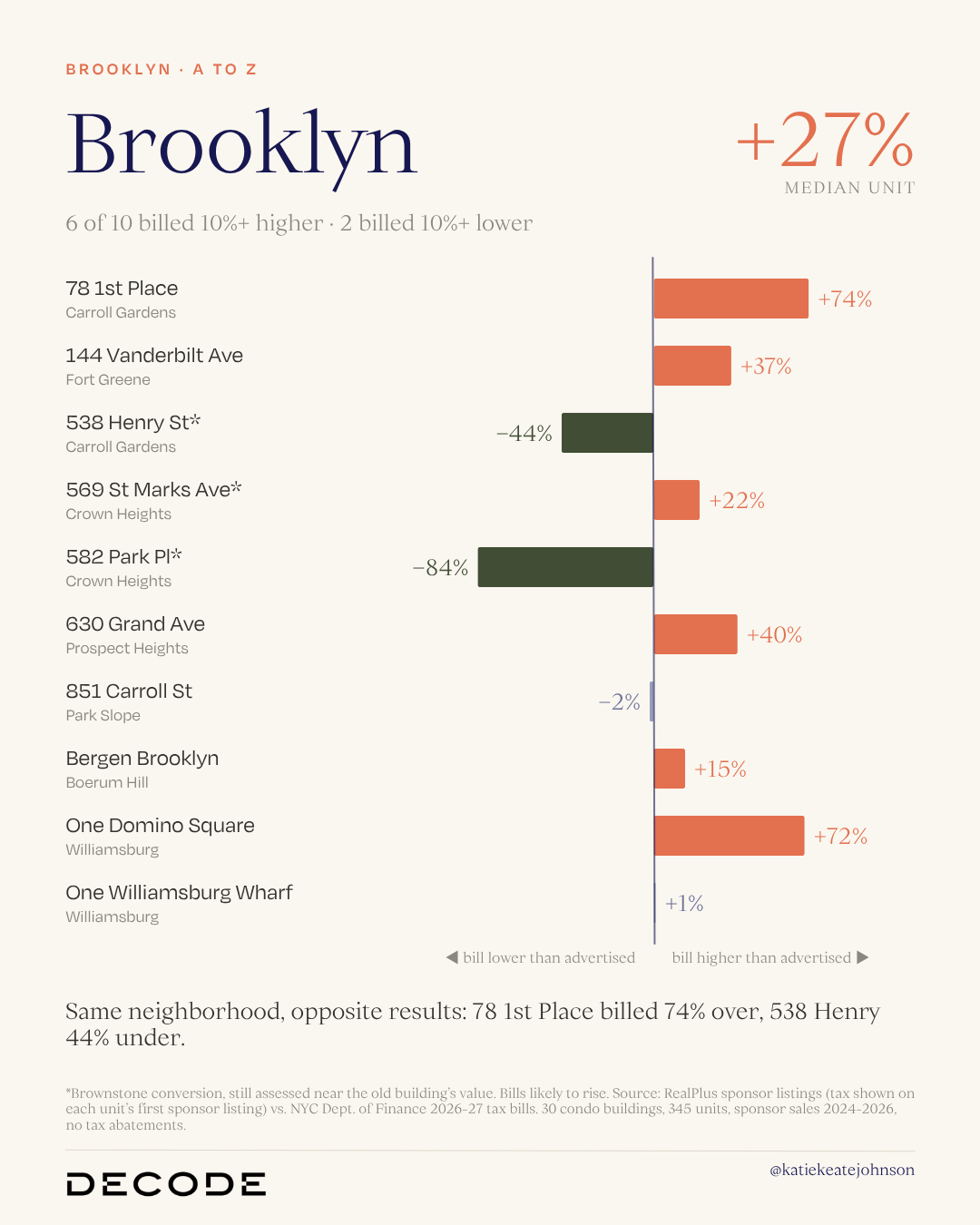
2. Brooklyn: the widest gap
Brooklyn · 10 new condo buildings · median unit vs. advertised tax
The median Brooklyn unit is billed 27% more than advertised. Two of the buildings that came in far lower are brownstone-scale conversions, and that low number is likely temporary (more in Good to Know).
78 1st Place: +74%
One Domino Square: +72%
630 Grand: +40%
144 Vanderbilt: +37%
569 St Marks: +22%
Bergen: +15%
One Williamsburg Wharf: +1%
851 Carroll: -2%
538 Henry: -44%
582 Park Place: -84%
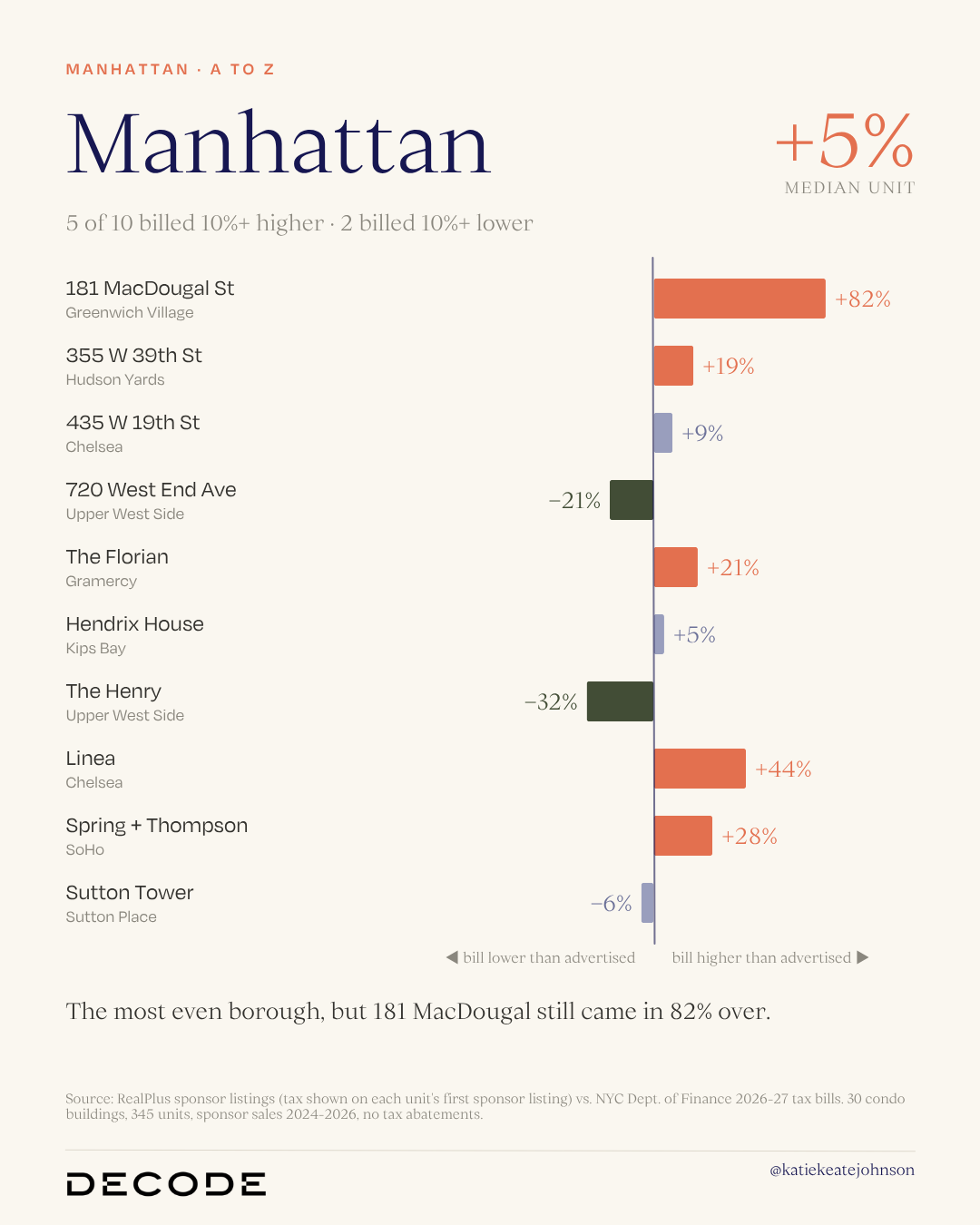
3. Manhattan: closest to the estimate, with big outliers
Manhattan · 10 new condo buildings · median unit vs. advertised tax
Manhattan's median unit is only 5% over, but the spread is wide. 181 MacDougal is billed 82% above its listings, while The Henry came in 32% under.
181 MacDougal: +82%
Linea: +44%
Spring + Thompson: +28%
Florian: +21%
355 W 39th: +19%
435 W 19th: +9%
Hendrix: +5%
Sutton Tower: -6%
720 West End: -21%
The Henry: -32%
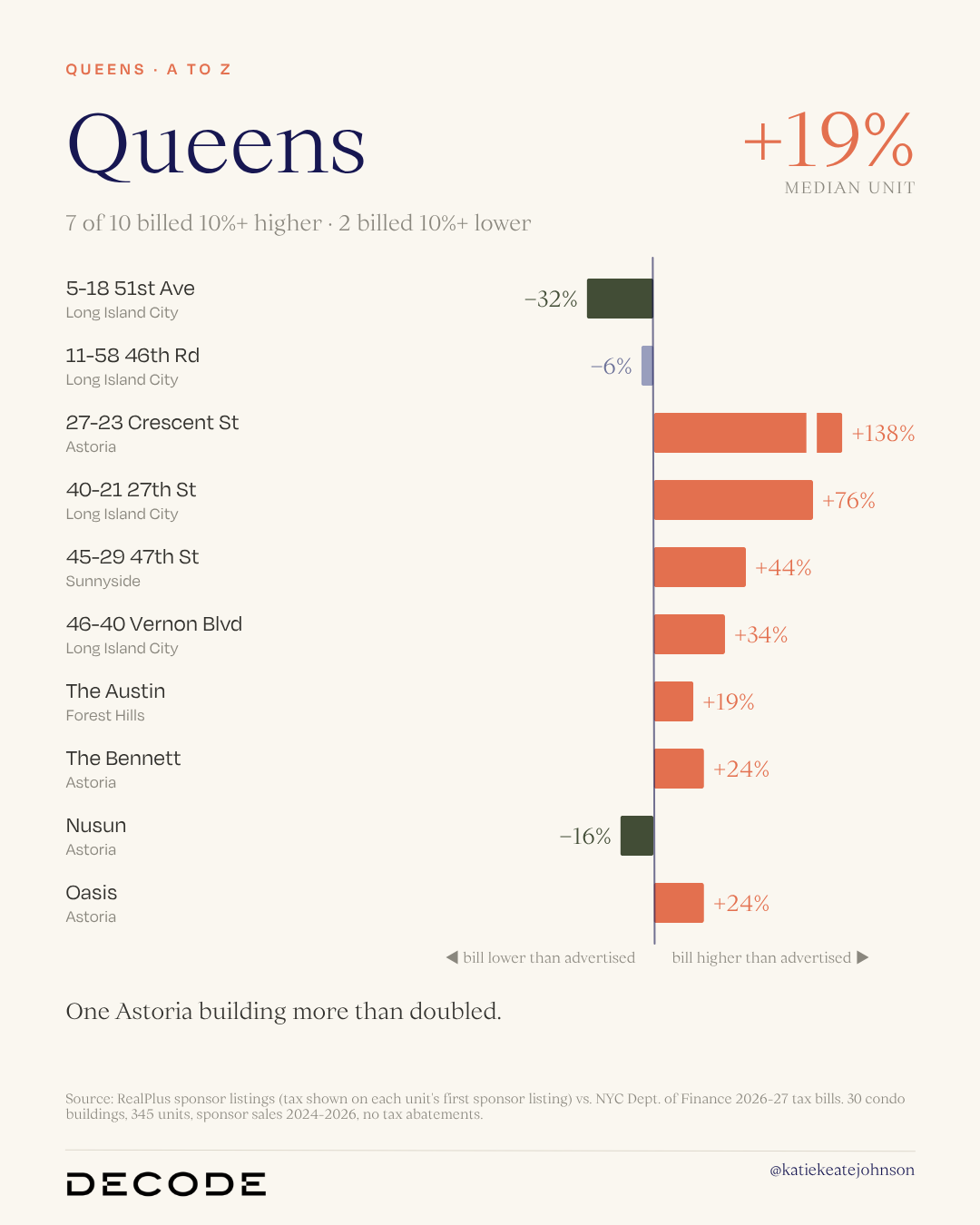
4. Queens: one bill more than doubled
Queens · 10 new condo buildings · median unit vs. advertised tax
The median Queens unit is billed 19% more than advertised. At 27-23 Crescent, the actual bill is more than double what the listing showed.
27-23 Crescent: +138%
40-21 27th St: +76%
45-29 47th St: +44%
46-40 Vernon: +34%
Bennett: +24%
Oasis: +24%
Austin: +19%
11-58 46th Rd: -6%
Nusun: -16%
5-18 51st Ave: -32%
5. What the miss costs in real dollars
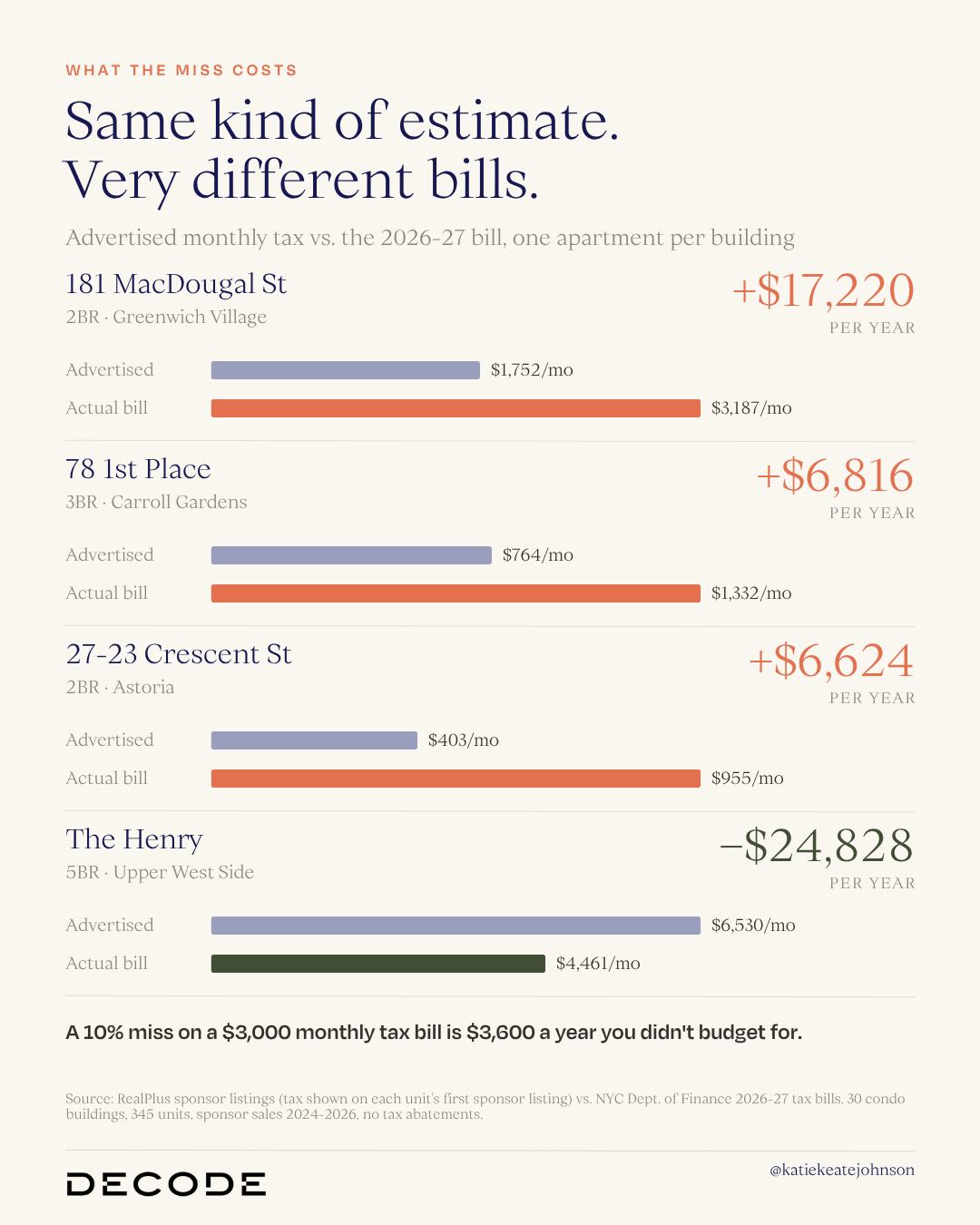
Real units · advertised monthly tax vs. actual monthly tax
Percentages are easy to shrug off. Here is what the gap looks like on actual units:
181 MacDougal 2BR: $1,752/mo advertised, $3,187/mo actual, +$17,220 a year
78 1st Place 3BR: $764/mo advertised, $1,332/mo actual, +$6,816 a year
27-23 Crescent 2BR: $403/mo advertised, $955/mo actual, +$6,624 a year
The Henry 5BR: $6,530/mo advertised, $4,461/mo actual, $24,828 a year less
A 10% miss on a $3,000 monthly tax bill is $3,600 a year you didn't budget for.
Good to Know
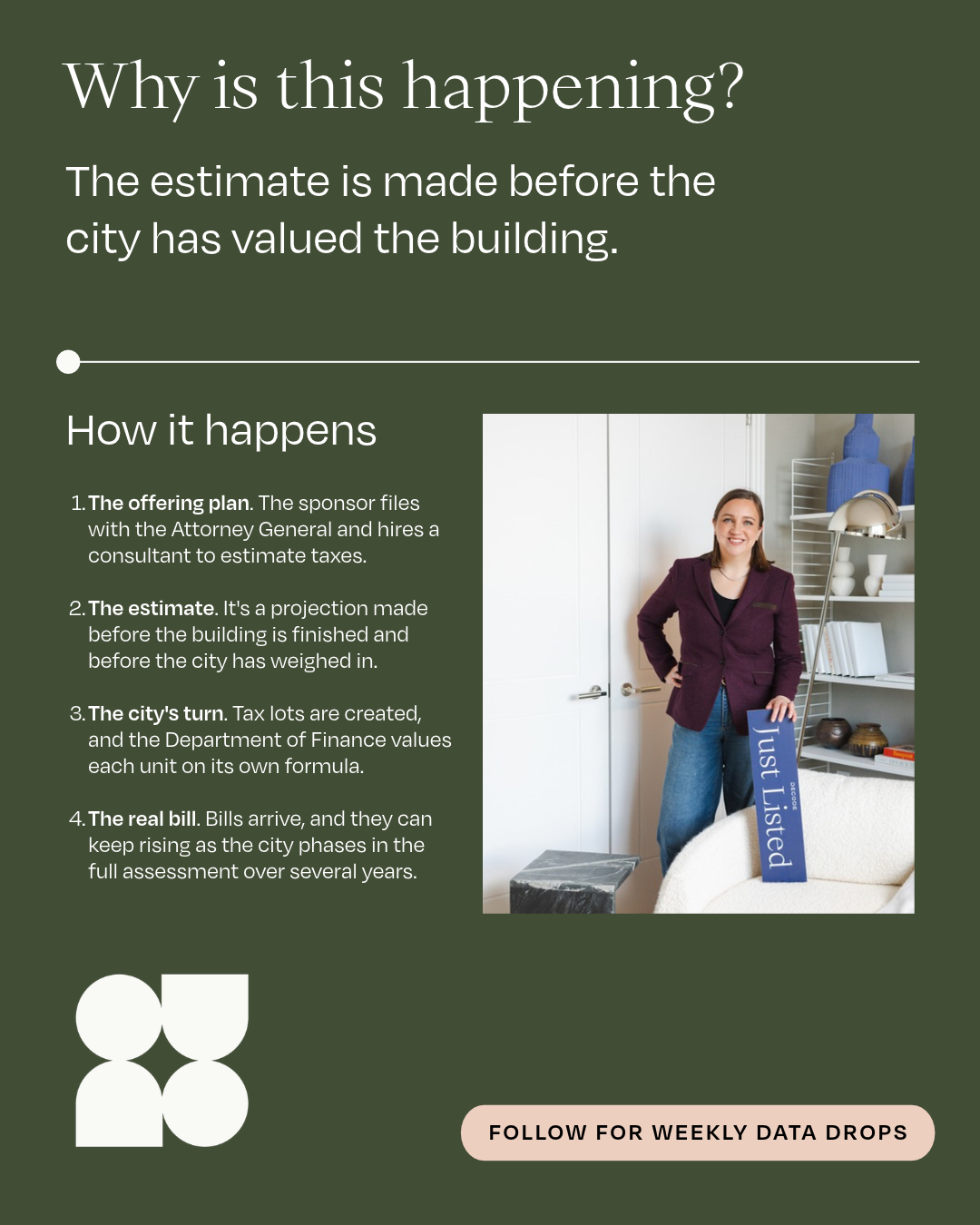
Why the estimates miss: the sponsor's tax estimate is written into the offering plan before the city has valued the finished building. Once the city assesses it, the real bill can land far from the estimate.
The bill can keep rising: assessment increases in condo buildings (tax class 2) phase in over 5 years, so this year's bill may not be the ceiling.
Some low numbers are temporary: brownstone conversions like 538 Henry and 582 Park Place are low for now because the old building's assessment was split across the new units, and caps on small buildings slow the increases.
Medians, not averages: borough and overall figures use the median unit, so a handful of outliers don't drive the result.
What's included: condo buildings with sponsor sales from 2024 to 2026 and no tax abatements.
Source: RealPlus sponsor listings (first sponsor listing for each unit) vs. NYC Department of Finance 2026-27 tax bills.
-
If you're buying new construction, treat the tax number on the listing as a placeholder, not a promise. Ask the sponsor's team whether the units have their own tax lots yet and whether the city has issued bills for them. If it has, look up the actual bill for your unit on the Department of Finance site before you sign.
Then budget for the gap. In this data the typical unit paid 15% more than advertised, and 27% more in Brooklyn. The bill can also keep climbing for a few years while the assessment phases in, so leave yourself room.
And if you're comparing two new buildings on monthly cost, compare actual bills wherever they exist, not two sponsor estimates. A lower bill than advertised does happen, but in this data it's the exception. Plan for higher.
What questions do you want real answers for?
Send me the question you can't get a straight answer on, about a building, a neighborhood, or the market. I'll dig into the data and reply with real numbers, no sales pitch. The best ones become a future Data Drop.
KEEP EXPLORING