

What Two New Towers Taught Me About Brooklyn Heights Condos
I have been tracking One Montague Place and the Bossert condos for a while now (the Bossert conversion will happen one day). Two big, upscale buildings headed for a neighborhood not known for new construction, which got me curious about how they actually fit into everything else going on in Brooklyn Heights.
So I did the very normal, well-adjusted thing and pulled the sales data on every condo building in the neighborhood, all 63 of them, and laid them out on one timeline by the year each was built and the year it became a condo. What came back genuinely surprised me, and it changed how I think about where this place is headed.
We bought our first condo here in 2012, at 55 Poplar Street, and back then a brand-new condo in the Heights still felt like a novelty. A decade later, two towers are on the way that would not look out of place in Manhattan. Here is what the data told me about how we got here, and what comes next.
The Short Version
Two large luxury projects are coming to Brooklyn Heights: One Montague Place (a roughly 50-story tower with about 46 condos) and the Hotel Bossert conversion (61 condos), adding about 116 for-sale units.
Most Brooklyn Heights condos are conversions of older buildings, not new construction. Of the neighborhood's 63 condo buildings, 51 are conversions and only 12 are ground-up.
On price, Brooklyn Heights now trades roughly on par with the Upper East Side on a blended basis (about $1,463 to $1,525 per square foot), and its townhouse market just set a $24.5 million borough record.
New development is likely to sell, but slowly. Even on the Upper East Side, new construction is the softest segment, sitting an average of 216 days on the market.
How new development came to Brooklyn Heights
The first thing the data made clear is that the condo is a relatively recent arrival here. I mapped all 63 condo buildings in Brooklyn Heights by the year each one actually became a condo, against the year the building was built. The picture is striking: 51 of the 63 are conversions of older buildings, and only 12 are ground-up new construction.
That makes sense once you remember what kind of neighborhood this is. Brooklyn Heights was the very first historic district in New York City, designated in 1965, which effectively froze new construction inside the district for decades. So for most of its modern history, the only way a new condo could exist here was to convert something old. My own building at 55 Poplar became a condo in 1987, in an 1880s structure. One Brooklyn Bridge Park, the largest condo building in the neighborhood at over 400 units, is a 1928 warehouse that converted in 2008.
The one real burst of ground-up building came between about 2014 and 2020, and almost all of it sat on the waterfront: Pierhouse, Quay Tower, and One Clinton. That was possible because Brooklyn Bridge Park opened up land the landmark rules did not touch. But that land is essentially spent now. Which is exactly why the next wave, One Montague Place and the Hotel Bossert conversion, is happening inland, in the historic core, at a scale the neighborhood has never had to absorb in one place. A handful of smaller conversions are coming too, like 29 Willow Street and 138 Joralemon Street. When you run out of waterfront in a landmarked neighborhood, the pressure moves inward.
Can the market absorb Brooklyn Heights' new condos?
This is the question I keep coming back to, because the two towers together add roughly 116 for-sale condos, more than half of them in these two Montague Street buildings, into a neighborhood that has historically absorbed only a small number of brand-new units a year.
Here is where the Upper East Side comparison earned its keep, and not in the way I expected. Even up there, in one of the deepest luxury markets in the country, new development is the softest, slowest segment of the market right now. Contracts on new development were down about 21 percent, and those units sat an average of 216 days on the market, versus 127 days marketwide. Resale condos, by contrast, were robust, with average prices up around 11 percent. In other words, premium Manhattan is telling us that new towers are the hardest part of the market to move, even when the neighborhood clearly has the buyers.
The encouraging counterpoint comes from our own recent new construction, and it is the sharpest data point in the whole exercise. One Clinton, the newest completed building of the last cycle, has held its value beautifully. Its resales are up roughly 11 percent on average, only about 7 percent of them sold for less than the owner paid, and price per square foot has climbed steadily since it opened. Pierhouse, the ultra-premium waterfront product, tells a more cautious story. Its resales are up only about 4 percent, nearly a quarter of them sold at a loss, and price per square foot has gone essentially sideways for a decade. The mid-premium new build held its value; the ultra-premium one did not.
That is the lesson worth carrying into the new towers. One Montague, at $5.9 million and up, is positioned much closer to Pierhouse than to One Clinton, so Pierhouse is the honest comp for whether these buildings will hold their asking premium once the resale market takes over. New construction in Brooklyn Heights has generally been a good store of value, but the very top of the market is exactly where that is least guaranteed.
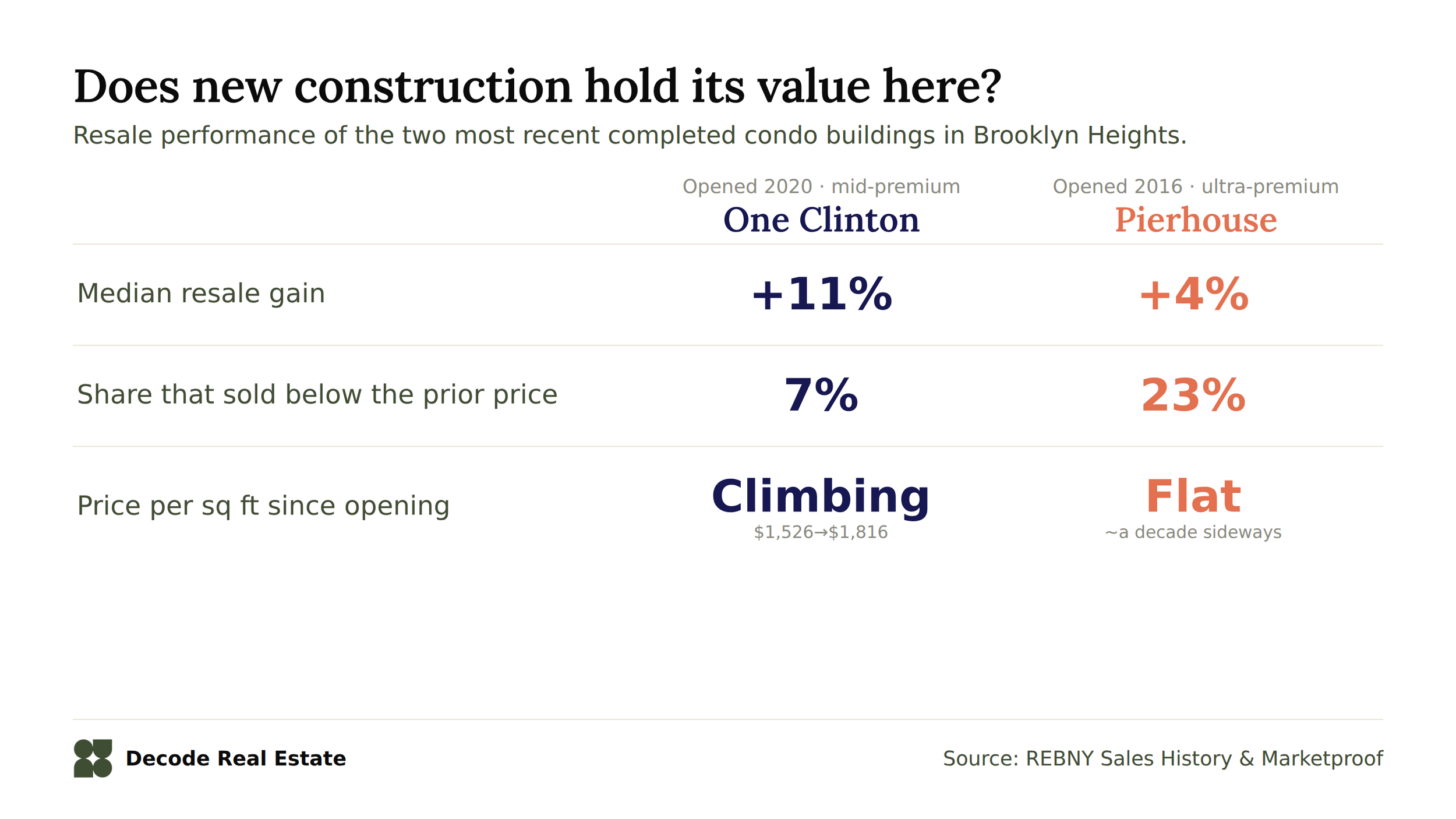
Comparison of One Clinton and Pierhouse resale performance in Brooklyn Heights, showing One Clinton held value better
Are Brooklyn prices the same as Manhattan? Brooklyn Heights vs Upper East Side sample
Now for the question underneath all of it. And the honest answer, on price, is that we are closer than I expected.
On a blended basis, Brooklyn Heights is already trading roughly on par with the Upper East Side. The Upper East Side, Lenox Hill, Yorkville, and Carnegie Hill together recorded sales in 2025 at about $1,463 per square foot. Brooklyn Heights overall is now running in the same range. The neighborhood that people used to describe as a value alternative to Manhattan is no longer priced like one.
It is worth being precise about what "more expensive" means here, because the neighborhood is bifurcating, not just drifting up as a whole. The top is setting records while the entry market barely moves. Co-op prices, long the affordable way into Brooklyn Heights, have sat roughly flat around $900,000. Over the same stretch, the townhouse median jumped from about $6.2 million to $8.2 million in two years, and new-construction condos now trade around $1,900 a foot, roughly a 30 percent premium over resale. The ceiling is rising fast while the floor holds, and that widening gap is the clearest sign of a neighborhood moving upmarket.
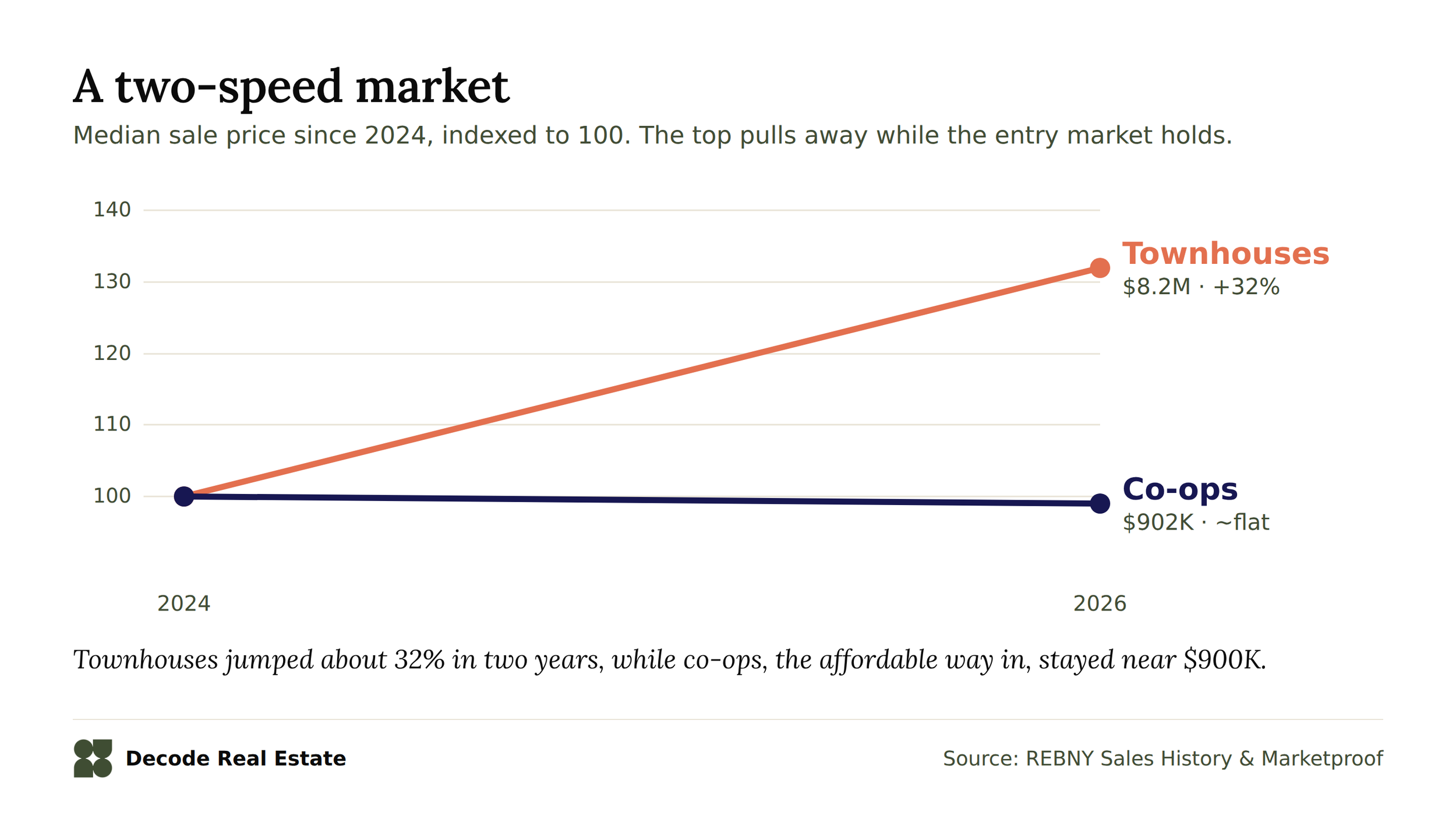
Chart showing Brooklyn Heights townhouse prices rising 32 percent since 2024 while co-op prices stayed flat
At the top end, the two markets are starting to rhyme. Upper East Side new development is currently selling around $2,270 to $2,310 per square foot, at an average price above $5 million. One Montague's early estimates put starting prices just under $2,000 a foot, but I would treat that as a floor, not a ceiling. That number is a placeholder for a building that will not start selling for about two years, and given where new development actually prices today, both on the Upper East Side and across premium Brooklyn, where Dumbo's Olympia recently traded a penthouse at $17.5 million, it would not surprise me at all to see One Montague launch north of $2,000 a foot and climb from there. The ultra-high end already tracks Manhattan directly: the Upper East Side luxury market averaged close to $8.8 million in 2025, and Brooklyn Heights just set a borough record of its own with a $24.5 million townhouse sale.
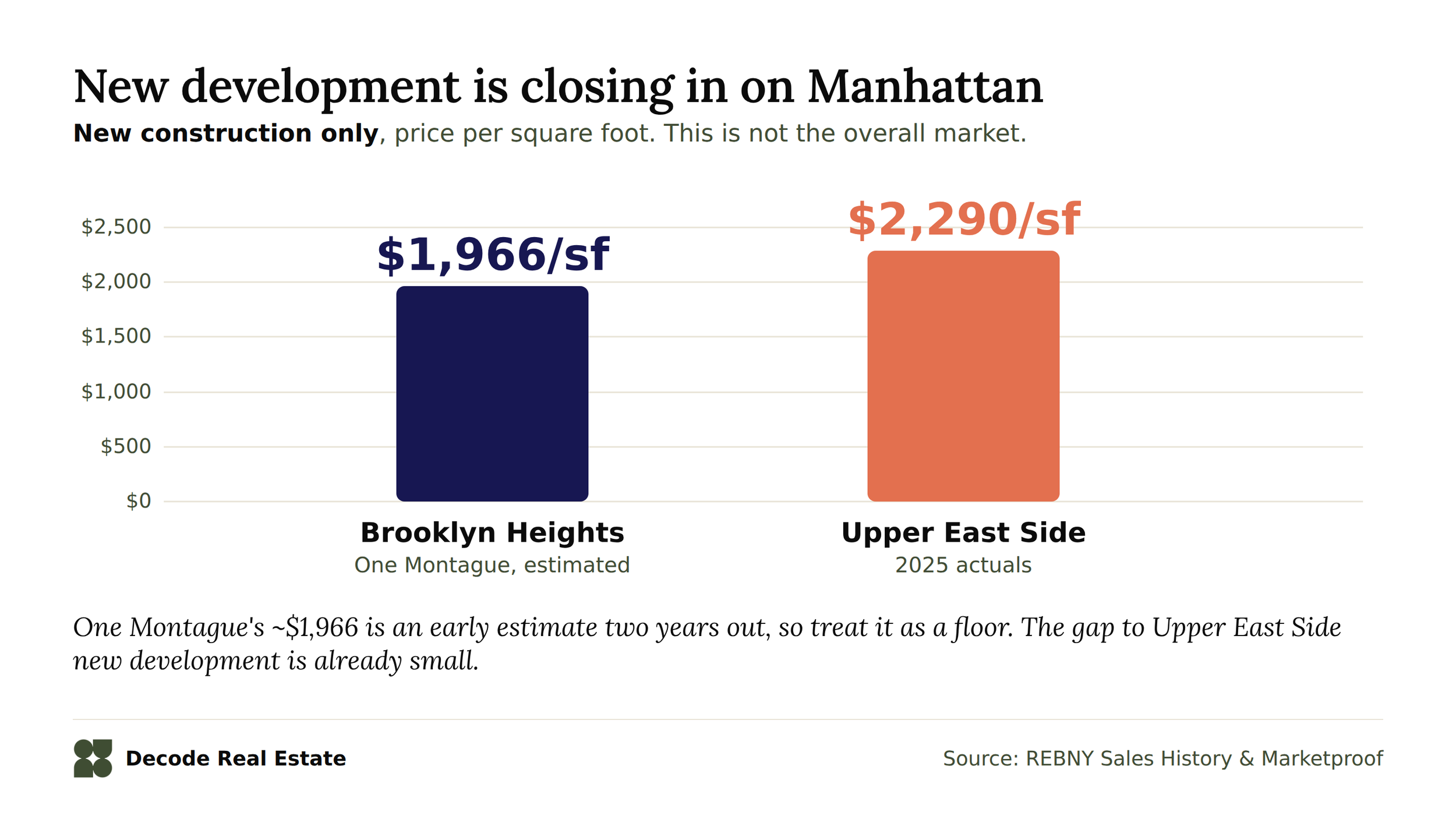
Bar chart comparing Brooklyn Heights and Upper East Side price per square foot, blended and for new development
Brooklyn prices are putting pressure on Manhattan. Will this trend continue? I think the answer is a bit of both- I see buyers who start in Brooklyn move to Manhattan because it’s easier to buy there. BUT Brooklyn’s popularity does not seem to be waning.
Where this leaves us
So, back to my three questions. These towers fit into a neighborhood that has always grown by conversion, in a brief second act of tower-building that is only just beginning. The market will likely absorb them, but slowly, because new development is the hardest segment to move even in the strongest luxury markets, and the very top tier is where value is least assured. And yes, on price, Brooklyn Heights has quietly started to operate like a premium Manhattan neighborhood.
Are you starting to explore your new home? Let’s Talk
Brooklyn Heights new development: frequently asked questions
What new condos are coming to Brooklyn Heights? The two largest are One Montague Place, a roughly 50-story tower at 205 Montague Street with about 46 condos plus rental units, and the Hotel Bossert conversion at 98 Montague Street, bringing 61 condos to a landmarked 1909 building. Several smaller boutique conversions are also in progress, including projects on Joralemon Street and Willow Street.
How much do new construction condos in Brooklyn Heights cost? New-construction condos in Brooklyn Heights have recently traded around $1,900 per square foot, roughly a 30 percent premium over resale. One Montague Place is expected to start around $5.9 million, with early per-square-foot estimates just under $2,000, though final pricing will not be set until sales launch, likely around 2027.
Is Brooklyn Heights as expensive as the Upper East Side? On a blended basis, close. Brooklyn Heights now trades in roughly the same per-square-foot range as the Upper East Side, and its ultra-luxury market is comparable, with a recent $24.5 million townhouse sale setting a Brooklyn record. Upper East Side new development still commands a premium per square foot, but the gap has narrowed sharply.
Will the Brooklyn Heights market absorb the new condos? Most likely yes, but gradually. New development is the slowest-moving segment of the luxury market even on the Upper East Side, where new units sit an average of 216 days on the market. Adding about 116 new condos to a small neighborhood in a short window means absorption is likely to take time.
How many units is One Montague Place? One Montague Place is planned as a mixed-use tower with roughly 46 condominium units alongside rental apartments, at 205 Montague Street in Brooklyn Heights.